
AT THE TOP
There is something different about watching a Sri Lankan leopard.
It is not simply the excitement of seeing one of the world’s most beautiful big cats. It is the feeling of watching an animal that sits at the very top of the food chain—an animal that has learned to survive in almost every corner of Sri Lanka’s wilderness.
The Sri Lankan leopard is the island’s apex terrestrial predator.
With no natural predator regularly hunting adult leopards, they occupy the highest level of the terrestrial food web. But being at the top does not mean living without challenges. It means carrying an important responsibility within the ecosystem.
Every ecosystem is connected by a delicate balance of predators and prey.
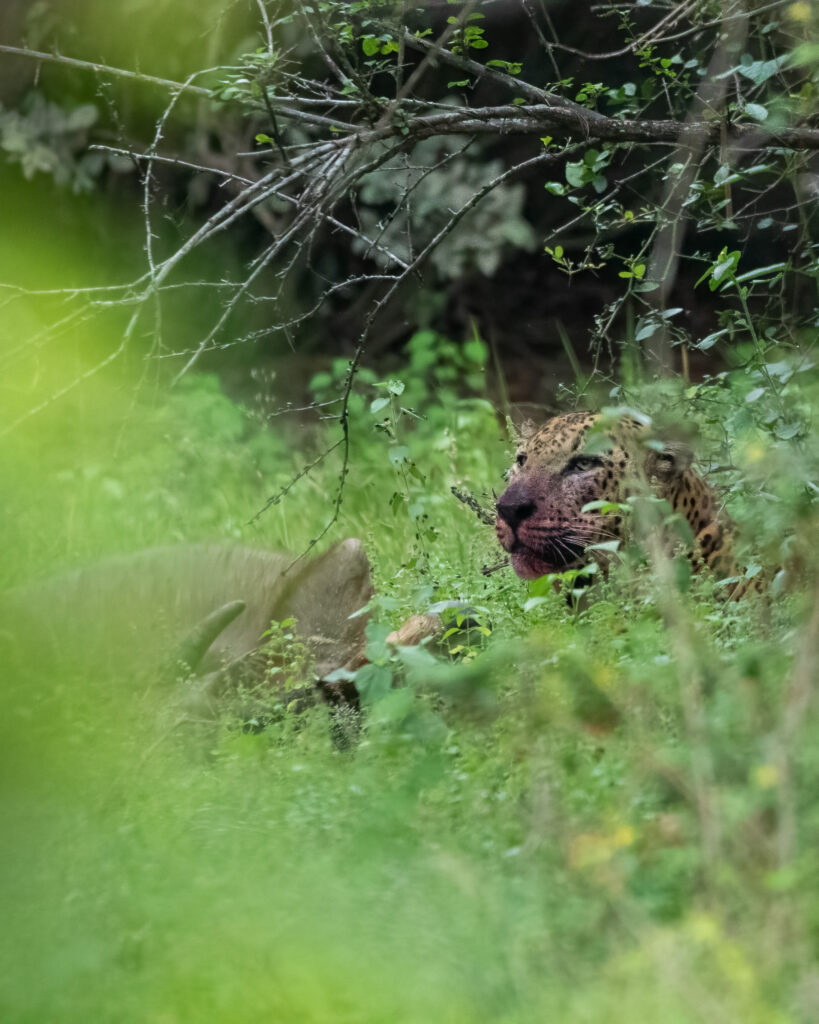
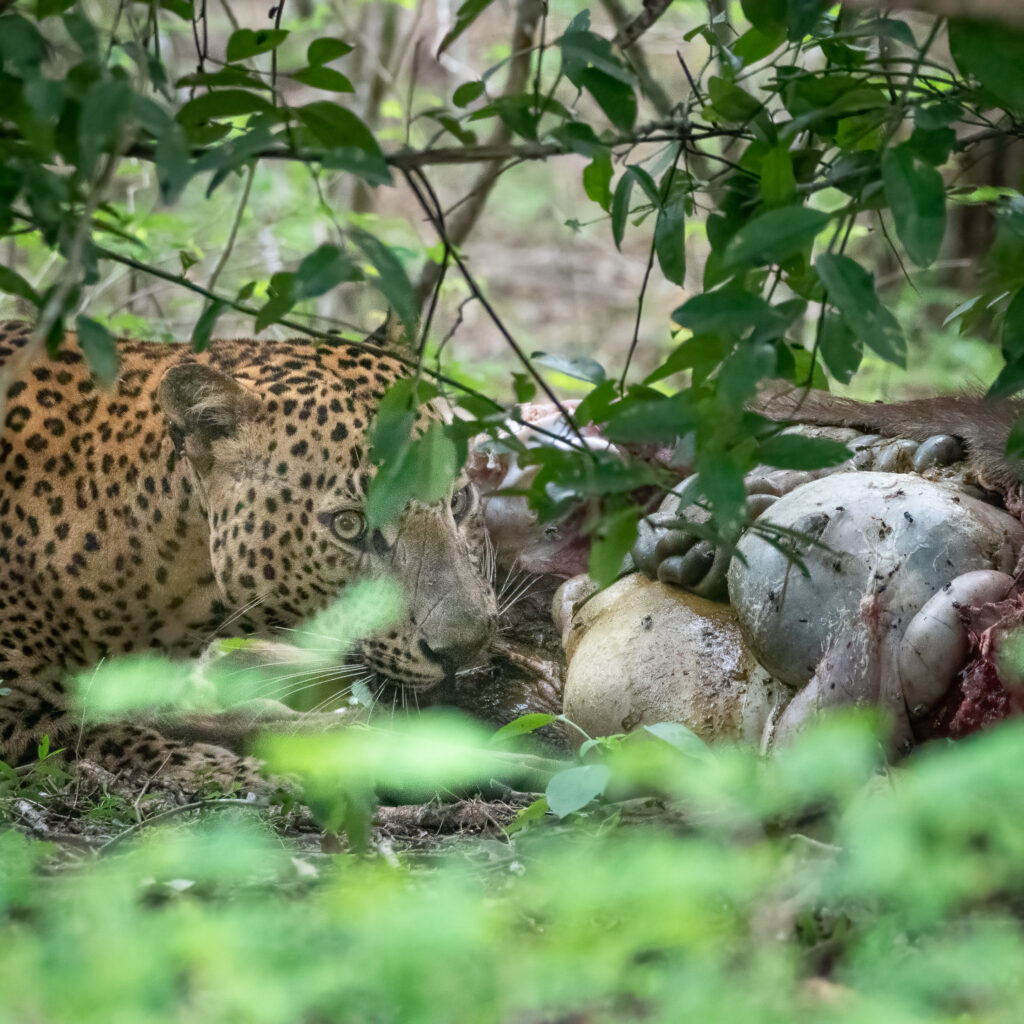
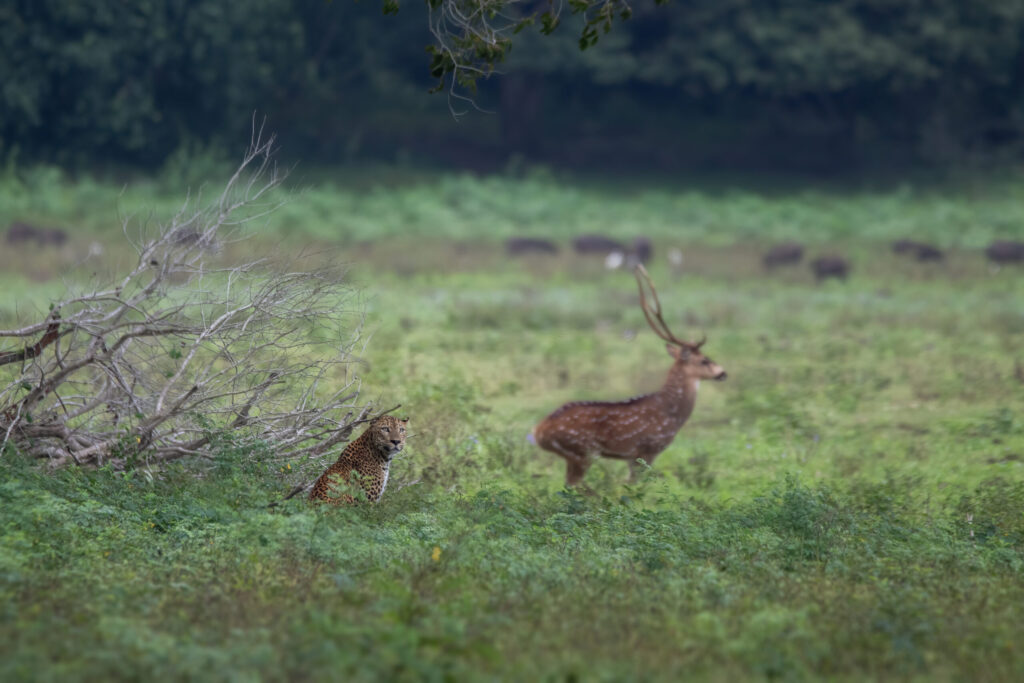
Leopards hunt a wide variety of animals, from deer and wild boar to monkeys, langurs, junglefowl and smaller mammals. They are opportunistic predators, capable of adapting their diet according to what is available in their surroundings.
This adaptability is one of the reasons the Sri Lankan leopard has been so successful.
Unlike some large predators that require vast areas of undisturbed wilderness, leopards can survive in remarkably diverse habitats. They inhabit dry forests, wet forests, grasslands, rocky terrain and even landscapes close to human settlements.
But their adaptability should never be mistaken for invulnerability.
The regulator
A healthy ecosystem needs predators.
Without predators, populations of herbivores and other prey species can increase beyond what their habitat can sustainably support. Increased grazing pressure can then affect vegetation, which affects other animals, which affects the entire structure of the ecosystem.
Predators therefore do much more than kill.
They regulate.
A leopard selecting an old, injured or vulnerable animal is participating in a natural process that has been occurring for thousands of years. Its presence influences the behaviour and distribution of prey animals, creating effects that can extend far beyond the individual animal it catches.
This is one of the reasons an apex predator can be considered an indicator of a functioning ecosystem.
Where a leopard can survive and reproduce, there must generally be enough prey, water, shelter and suitable habitat to support it.
The leopard is therefore not merely part of the ecosystem.
It is evidence of the ecosystem.
A predator built for Sri Lanka
The Sri Lankan leopard is a unique island subspecies, Panthera pardus kotiya.
Unlike many leopard populations elsewhere in Asia and Africa, Sri Lankan leopards have evolved without having to share their landscape with another large cat such as a tiger or lion.
That has influenced their ecological role.
In Sri Lanka, the leopard occupies the position that several different large carnivores may occupy elsewhere.
It is an incredibly versatile predator.
It can hunt on the ground, climb trees, move silently through thick vegetation and travel considerable distances in search of food. It can bring down prey substantially larger than itself, yet it is equally capable of surviving on smaller animals when necessary.
This flexibility becomes particularly important in an island environment where habitats can change dramatically over relatively short distances.
From the dry-zone forests of Yala and Wilpattu to the wetter forests of the central and southwestern parts of the island, the leopard has demonstrated an extraordinary ability to adapt.
The silent hunter
Perhaps the most remarkable thing about the leopard is how little we see.
A leopard can be living in the same forest for years without most people ever seeing it.
Its spotted coat breaks up its outline among leaves and shadows. Its movements are quiet. It can remain motionless for long periods, waiting for the right opportunity.
Even when you are driving through leopard country, there may be one watching you from somewhere nearby.
A pair of eyes between the branches.
A silhouette on a rock.
A tail disappearing behind the bushes.
Then, suddenly, it is gone.
This secrecy is part of what makes encountering a leopard so special.
You are not simply seeing an animal.
You are seeing an animal that has mastered the art of remaining unseen.
Life at the top is not easy
Being an apex predator does not make the leopard immune to danger.
Habitat loss, fragmentation, road traffic, snares, poisoning, retaliatory killing and the gradual loss of prey can all threaten leopard populations.
And increasingly, another danger comes from us simply occupying more of the landscape.
As forests become fragmented and human settlements expand, the boundaries between leopard habitat and human activity become increasingly blurred.
A leopard does not understand that a particular line on a map marks the edge of a national park.
It follows prey.
It follows water.
It follows the landscape.
And sometimes that landscape leads it into places where humans live.
This is where the survival of an apex predator becomes a question of coexistence.
Why the leopard matters
It is easy to look at a leopard and see a beautiful animal.
A photographer sees the eyes, the rosettes, the muscles and the expression.
A tourist sees an unforgettable safari encounter.
A researcher sees a predator with a complex ecological role.
But the leopard is much more than any of these things.
It represents a functioning wild system.
Protecting the leopard means protecting the prey species it depends on. It means protecting forests, grasslands, water sources and corridors. It means maintaining enough space for wildlife to move naturally.
And because the leopard is at the top of the food chain, protecting it can have consequences that reach all the way down through the ecosystem.
Remove the predator, and the balance changes.
Protect the predator, and we protect something much larger than a single species.
The king without a crown
There is no crown on the head of a Sri Lankan leopard.
No throne.
No roar announcing its presence across the forest.
It simply walks through the darkness, almost invisible, carrying the responsibility of an apex predator.
Sometimes it lies on a rock overlooking the forest.
Sometimes it disappears into thick vegetation.
Sometimes it climbs a tree with the remains of its meal.
And sometimes, for a fortunate few, it steps onto the road and looks directly towards the vehicle.
For a few seconds, the forest seems to stop.
You are looking at an animal that has survived generations of change and continues to occupy the highest position in Sri Lanka’s terrestrial food chain.
But its survival is not guaranteed.
The leopard may be at the top of the food chain.
We are at the top of the world it lives in.
And ultimately, its future depends on what we choose to do with that position.