
FIRST LESSONS
Some wildlife encounters stay with you because of what you see.
Others stay with you because of when you see them.
This was my last visit to the wild before leaving Sri Lanka and moving to Finland. I did not know at the time exactly how much this particular sighting would come to mean to me. I only knew that I wanted one more morning in the forests I had grown up visiting, one more opportunity to sit quietly among Sri Lanka’s wildlife and let the wilderness unfold in front of me.
That final visit took me to Wilpattu National Park.
And the forest gave me something extraordinary.
We came across a group of five leopards gathered around the carcass of a sambar deer. Among them were two adult males, along with younger leopards. Seeing five leopards together was exceptional in itself. Leopards are generally solitary animals, so an encounter involving several individuals around a large kill is something that does not happen every day.
The carcass had brought them together.
But while the adults concentrated on the meal, something else was happening nearby.
One of the younger leopards was learning.
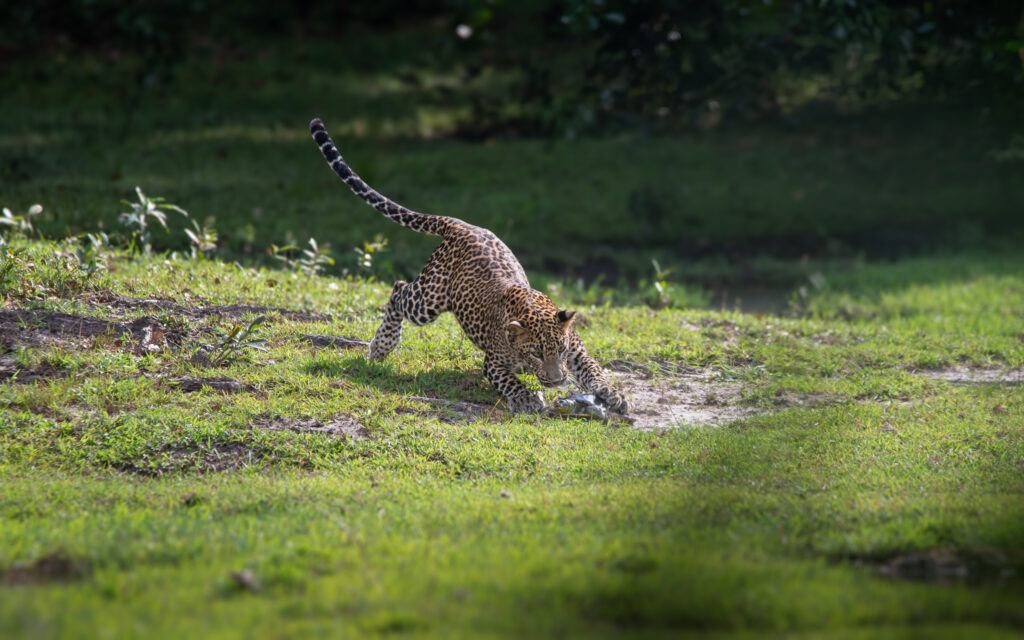
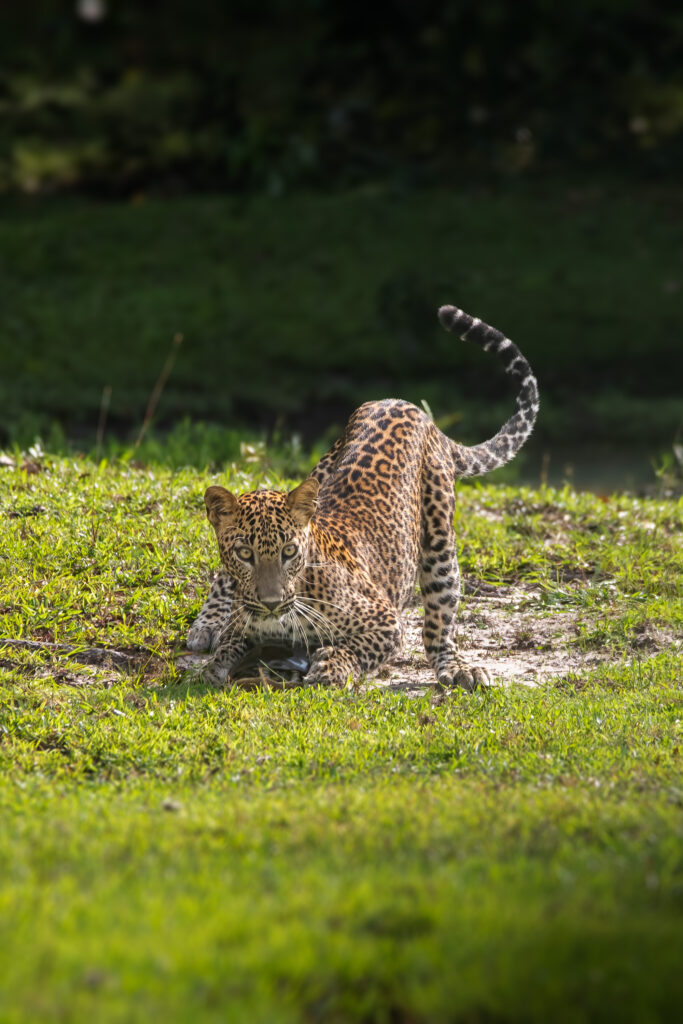
A small tortoise had caught its attention.
The cub suddenly began chasing it, turning what might have looked like a simple game into a fascinating display of instinct and curiosity. It caught the tortoise and began playing with it, pawing at it and moving around it.
For a while, it seemed almost playful.
But watching it, I couldn’t help wondering if I was seeing something more important.
Perhaps this was one of the first lessons in becoming a hunter.
Eventually, the young leopard carried the tortoise towards the bushes and disappeared with it.
We cannot know exactly what was going through the cub’s mind. But young predators do not become successful hunters overnight. Hunting is a skill developed through experience, experimentation and repeated practice.
And this is where encounters like this become particularly fascinating.
Learning to hunt
For a young leopard, the world is a classroom.
Before it can successfully hunt larger and more difficult prey, it must learn how to stalk, chase, grab, hold and control an animal.
Young leopards are known to engage with smaller prey and objects during their development. Rabbits, birds such as peafowl and other small animals can provide opportunities for young predators to develop coordination and hunting skills.
What appears to us as play can therefore have a much more important purpose.
A cub chasing a rabbit is learning how to close the distance.
A cub stalking a peacock is learning patience and concealment.
A cub pouncing on something small is learning how to coordinate its body with its instincts.
A cub wrestling with its siblings is learning how to control its strength and movement.
And a cub interacting with a tortoise may be experimenting with how to approach, grab and handle unfamiliar prey.
None of these attempts guarantee a successful hunt.
But each attempt is experience.
And experience is what eventually turns a young leopard into an efficient predator.
From play to survival
The transition from cub to independent leopard is not an easy one.
The safety of the mother will eventually disappear. The cubs will have to find their own territories, locate prey and learn to survive without relying on their mother for food.
Every successful hunt will matter.
Every failed attempt will teach them something.
The young leopard we watched that day was still far from becoming the powerful predator it would eventually be. But for a brief moment, we were able to see part of that journey.
It was not a dramatic chase after a sambar.
It was not a spectacular kill.
It was something much smaller.
A leopard cub chasing a tortoise.
Yet sometimes the smallest moments reveal the most about an animal’s life.
A final memory
There was another reason this sighting felt special to me.
I didn’t know when I would next be sitting in a Sri Lankan national park.
Sri Lanka had been home to my wildlife photography since childhood. The forests, the dry-zone landscapes, the early morning safaris and the anticipation of finding something hidden beyond the next bend had become part of my life.
This was my last visit to the wild before moving to Finland.
And somehow, the wilderness gave me exactly what I needed.
Five leopards.
Two powerful males.
A sambar carcass.
And a young leopard beginning to discover what it means to be a hunter.
I remember watching that cub with the tortoise and thinking about the future.
One day, that tiny leopard would have to survive on its own.
The playful chase would become a serious pursuit.
The small prey would eventually be replaced by larger and more challenging animals.
The curiosity would become experience.
The clumsy attempts would become precision.
And somewhere deep inside that young leopard was the potential to become an exceptional hunter.
We often celebrate wildlife for the dramatic moments—the kill, the chase, the confrontation.
But wildlife is also about everything that happens before those moments.
The lessons.
The mistakes.
The practice.
The patience.
The years of learning that turn a vulnerable cub into an animal capable of surviving at the top of the food chain.
As I watched that young leopard disappear into the bushes with the tortoise, I couldn’t help feeling that I was witnessing the beginning of something.
Perhaps years later, that cub would become a powerful leopard with a territory of its own.
Perhaps it would become a successful hunter.
Perhaps it would raise cubs of its own.
I would never know.
But that is the beauty—and sometimes the sadness—of wildlife photography.
We are allowed only a brief window into an animal’s life.
We arrive.
We watch.
We photograph.
And eventually, we leave.
The leopard remains.
Still learning.
Still hunting.
Still becoming what it was born to be.
And for me, that young leopard will always be part of my final chapter in the Sri Lankan wilderness before beginning a completely new one in Finland.