
A SHARED HOME
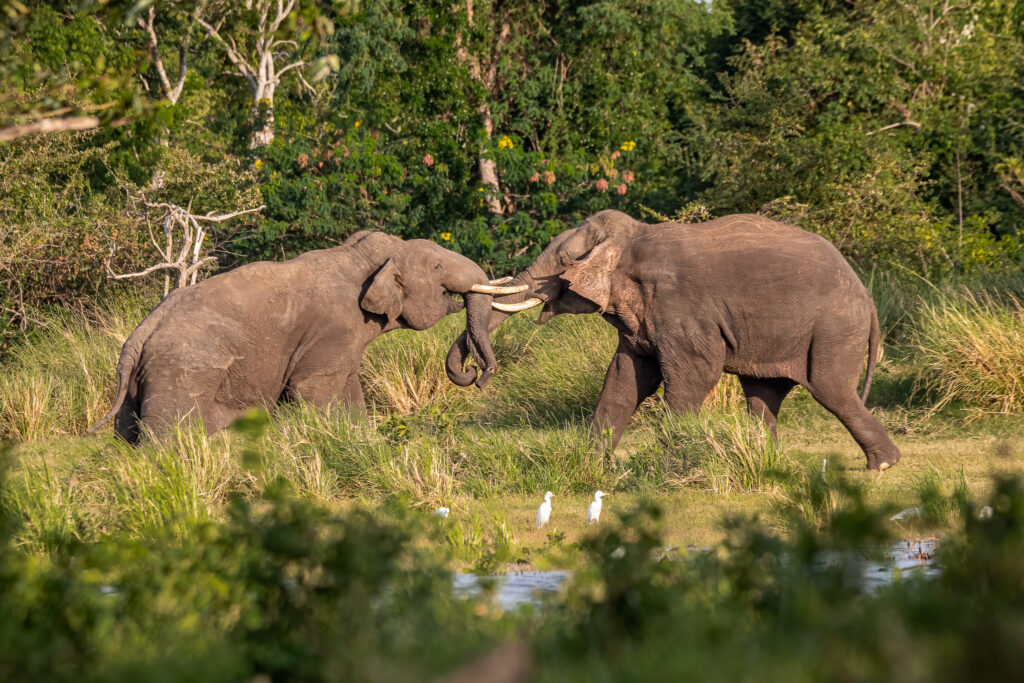
The photograph on the cover of this story is difficult to look at.
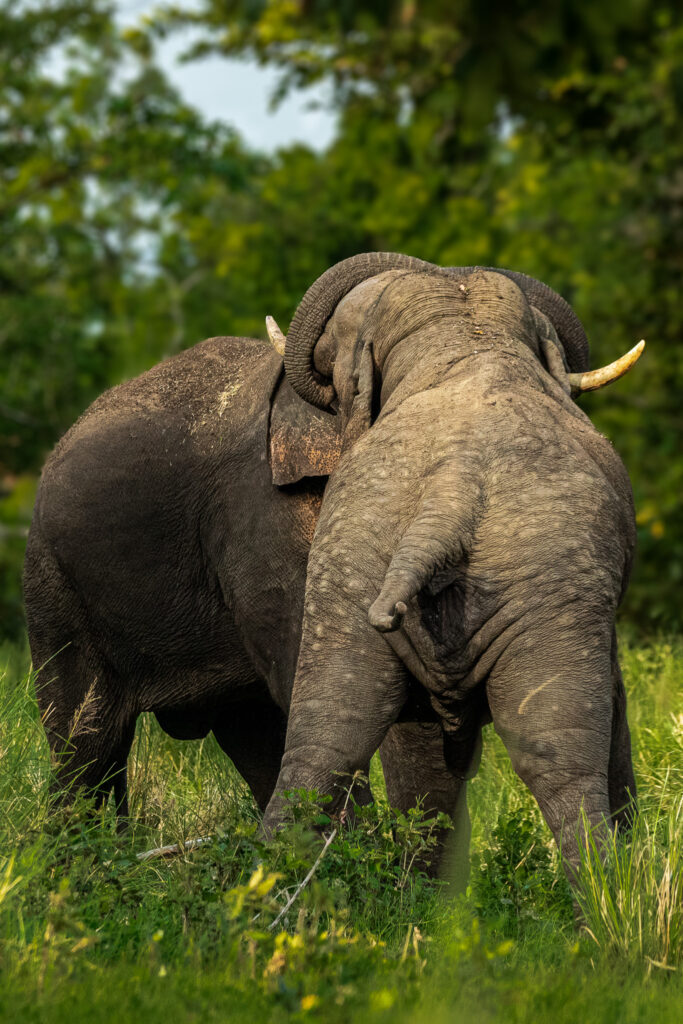
Two enormous tuskers, Mangala and Esala II, are fighting. They are powerful, magnificent animals, built to dominate their surroundings. But look closely at Esala II’s back and another story becomes visible.
More than a hundred pellet wounds are visible across his body.
This is not unusual for elephants living outside the boundaries of national parks.
Behind the beauty of Sri Lanka’s wild elephants is a conflict that has become one of the country’s greatest conservation and humanitarian crises. And the uncomfortable truth is that there are no real winners.
Between 2015 and 2024, official parliamentary figures record approximately 3,477 wild elephants and 1,190 people killed in human-elephant conflict in Sri Lanka. The problem has become particularly severe in recent years: 2,011 elephants and 734 people died between 2020 and 2024 alone.
Every number represents a life.
An elephant killed by an electric fence.
A farmer returning home who encounters an elephant in the darkness.
A calf left without its mother.
A family losing a father.
A tusker carrying scars from years of being shot at.
And somewhere between all these deaths is a much bigger question:
How did we reach a point where humans and elephants are fighting for the same piece of land?
The fences we trust
Electric fencing has become one of the most common tools used to reduce encounters between elephants and people.
In principle, it makes sense.
But an electric fence is only effective if it is properly designed, correctly powered, regularly inspected and maintained.
I have seen how quickly that assumption can fall apart.
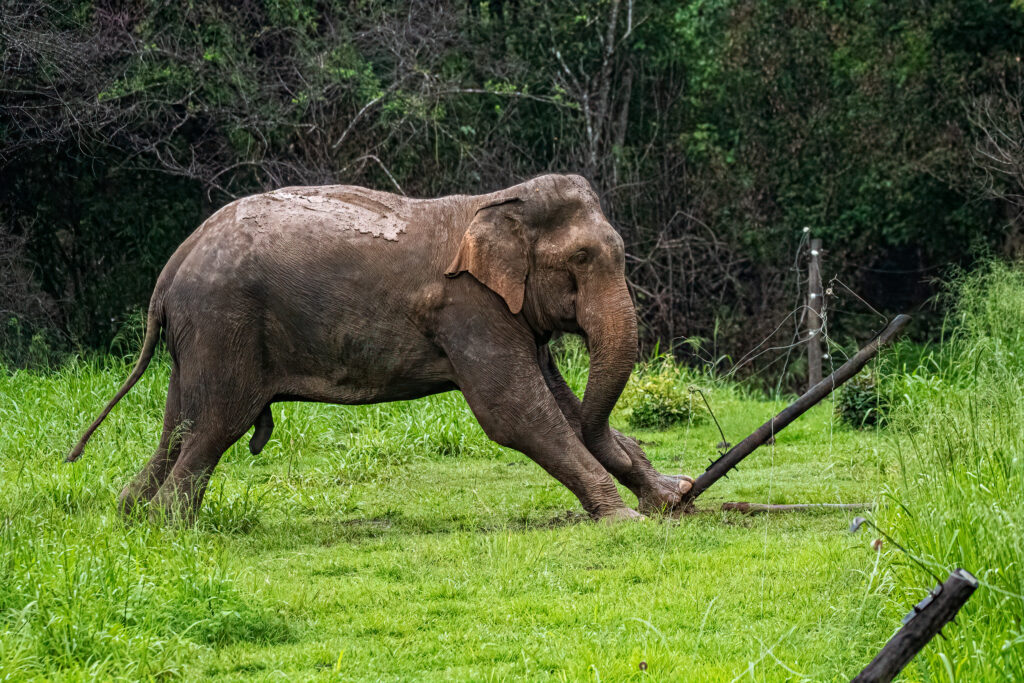
One of the photographs from my experiences shows an elephant approaching an electric fence. Instead of turning away, the elephant pushes through it. Within roughly a minute, the barrier that was supposed to separate an elephant from human habitation has effectively become meaningless.
This is not simply a story about an elephant being unusually intelligent or determined.
Research in Sri Lanka has documented elephants repeatedly challenging and crossing electric fences. A long-term camera-trap study around Udawalawe National Park recorded 3,097 fence crossings during 605 days of monitoring.
Other research has found that government-financed fences can become damaged and poorly maintained, while private fences can create additional problems by blocking elephant routes and diverting elephants towards neighbouring properties.
A 2025 University of Peradeniya study of communities in elephant-conflict areas found poor maintenance of private electric fences, limited knowledge of regulations and problems with voltage management. In the surveyed areas, fewer than half of respondents knew the relevant policies and regulations.
A fence that does not work does more than fail to protect a farmer.
It can create a false sense of security.
And a badly designed or illegally electrified fence can become a weapon.
The corridors we blocked
Elephants do not understand our property boundaries.
They do not know where a village ends, where a national park begins, or where a road has been constructed.
For generations, they have moved through landscapes according to the availability of water, food and shelter.
Those routes are their corridors.
But many of these routes have gradually been occupied by houses, farms, roads, infrastructure and other development.
Sri Lanka’s Parliament has previously been told that 16 major elephant corridors had been blocked, contributing to elephants entering villages.
More recently, the government has again acknowledged the problem. In June 2026, the Cabinet reported that rapid blockage of elephant habitats and migration routes by development projects and human activity has directly contributed to the escalation of human-elephant conflict. The government has begun identifying and declaring additional elephant corridors, including routes in Monaragala and Hambantota.
When an elephant’s traditional route disappears, the elephant does not simply decide to stop moving.
It looks for another way.
And sometimes that new way goes directly through somebody’s home.
The railway
Perhaps one of the most heartbreaking examples is the railway.
A railway line is an entirely human structure. But to an elephant moving through its traditional range, it can simply be another part of the landscape.
The consequences can be devastating.
According to an Auditor General report, 53 wild elephants were killed and 17 injured in train collisions between 2020 and 2024. The same report noted that despite earlier surveys and joint programmes intended to reduce these accidents, collisions remained a major problem.
In 2023 alone, 24 elephants were reported killed by trains, followed by 9 in 2024 according to reporting based on wildlife data.
These are not simply accidents involving animals wandering onto railway tracks.
They are collisions between two very different worlds.
A railway operates according to timetables, speed limits and infrastructure.
An elephant operates according to memory, instinct, food, water and traditional movement routes.
When those two systems occupy the same landscape, something has to change.
When protection changes the habitat
There is another part of this problem that is rarely discussed.
We often imagine a national park as a place where everything is automatically protected and therefore everything must be getting better.
Nature does not always work that way.
When an area becomes protected, human activities such as cutting, burning and grazing may be reduced. Over time, open grasslands can undergo natural succession, with shrubs and trees taking over areas that were previously open.
That can be beneficial for some species.
But it is not necessarily beneficial for elephants.
Elephants are remarkably adaptable feeders, but grass is an important part of their diet, particularly in Sri Lanka’s dry-zone landscapes. Research at Udawalawe identified 63 elephant fodder plants, with fodder concentrated particularly in scrub forest and grassland, and found that elephants behaved more like grazers than browsers throughout the year.
More importantly, a study of Udawalawe National Park comparing satellite imagery from 2005 to 2019 found that forest and scrub increased while grassland declined considerably, mainly because of scrub invasion. The researchers warned that declining grassland and food resources could push elephants towards the surrounding villages and agricultural land.
So the irony is painful.
We protect the forest.
The forest becomes denser.
The open grassland decreases.
Food availability changes.
And the elephant walks towards the boundary.
Beyond that boundary may be a village.
And beyond the village may be a field full of crops that are far more nutritious and attractive than what remains available inside the forest.
To the farmer, the elephant is destroying a livelihood.
To the elephant, it is simply looking for food.
Both are responding to the landscape in front of them.
The people living on the frontline
It is easy, especially for someone looking at wildlife photographs, to see the elephant as the victim and the human as the aggressor.
But the reality is more complicated.
Many of the people living in Sri Lanka’s dry-zone villages did not choose to become part of a conservation conflict.
They are farmers.
They grow crops.
They have houses to protect.
They have children walking home from school.
They may lose an entire season’s harvest in a single night.
They may be afraid to walk outside after dark.
And some have lost family members.
Research into HEC in Sri Lanka has found that land-use decisions, encroachment into elephant corridors, changes in agriculture and development are important drivers of conflict. Another nationwide study found that vegetation availability, agricultural land, population density and proximity to elephant ranges are important predictors of HEC risk.
That is why simply telling villagers to “protect the elephants” is not enough.
They need knowledge.
They need practical methods to protect themselves.
They need properly designed and maintained barriers.
They need to understand elephant behaviour.
They need early-warning systems.
And they need to understand why an elephant may suddenly appear in a place where it was rarely seen before.
Education is not a luxury in these communities.
It is part of conservation.
Coexistence is not optional
There is a temptation to believe that the answer is to keep elephants inside national parks and people outside them.
But Sri Lanka’s reality does not allow such a simple solution.
Elephants already live across a landscape shared with people. Some protected areas are surrounded by agriculture and settlements. Corridors cross human-dominated landscapes. Roads and railways cut through elephant ranges.
The question is therefore not whether humans and elephants will share the island.
They already do.
The question is whether we can learn to share it without killing each other.
That means protecting and reconnecting important elephant corridors.
It means making sure electric fences are placed where they actually work, rather than simply building more kilometres of fencing.
It means maintaining those fences.
It means preventing dangerous private electrification.
It means making railway crossings safer and reducing train collisions.
It means managing grasslands and other elephant habitats rather than assuming that simply leaving every protected area untouched will automatically provide the best habitat.
It means educating communities before conflict happens, rather than after someone has died.
And it means listening to the people who live alongside elephants.
Not an elephant problem. Not a human problem.
Perhaps we should stop calling this simply a “human-elephant conflict.”
Because that phrase makes it sound as if two equal sides have decided to fight.
They haven’t.
An elephant does not wake up wanting to attack a farmer.
A farmer does not wake up wanting to kill an elephant.
Both are responding to pressure created by a rapidly changing landscape.
The elephant is looking for food, water and a route through a landscape it has used for generations.
The farmer is trying to protect a home and a crop that may determine whether his family has enough to live on.
Somewhere between those two needs, our roads, farms, fences, settlements and other developments have created a collision course.
And the result is visible on the body of an elephant like Mangala.
More than a hundred pellet wounds.
Each one a reminder of a confrontation.
Each one a reminder that this magnificent animal has spent part of its life surviving us.
But the saddest part is that Mangala is not an isolated case.
Across Sri Lanka, elephants carry bullet wounds, scars, broken bones and other injuries. Humans carry their own scars—physical, emotional and financial.
We cannot photograph our way out of this crisis.
We cannot fence our way out of it.
We cannot simply drive elephants into another forest and hope the problem disappears.
And we cannot ask rural communities to bear the entire burden of elephant conservation.
We have to learn to share the landscape.
Because coexistence is not about choosing elephants over people.
It is about creating a future where neither has to die for the other to live.